Pillow, Mattress or Position? Sleeping Well With Pain
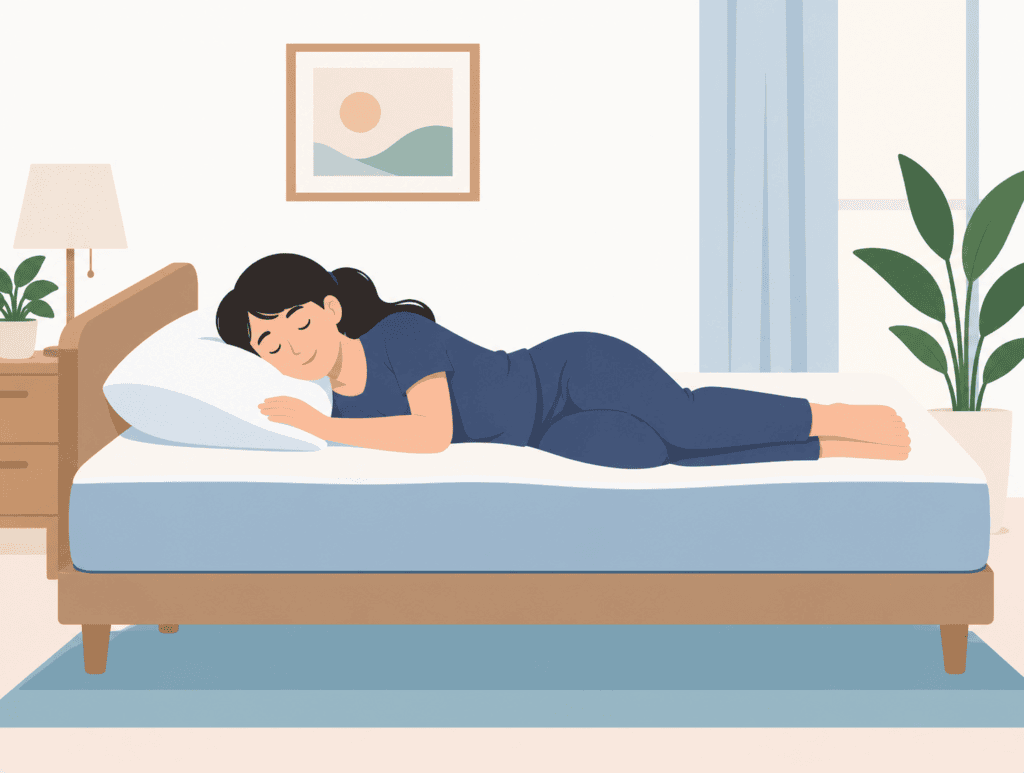
You go to bed sore and wake up stiffer. Your neck won’t turn properly, your lower back takes a few minutes to loosen, or you’ve rolled onto that shoulder at 3am and been woken by it.
When something hurts, it’s natural to start blaming the bed. A new pillow, a firmer mattress, a different way of lying down. Some of those changes help. Some just cost money. Whatever brought you here, welcome. Let’s break it down.
Sleep and Pain, Explained Simply
Sleep is when a lot of your recovery happens. Tissue repair, the settling of inflammation, and your nervous system’s sensitivity to pain are all influenced by how well and how long you sleep.
The relationship runs both ways. Pain makes it harder to sleep, and poor sleep tends to make pain feel worse the next day. Breaking that loop, even a little, can make a real difference to how you recover.
There’s no single perfect position, pillow or mattress. What matters is finding a setup that keeps you comfortable and supported for the injury you have right now.
Sleeping Positions by Problem Area
The best position is usually the one that takes load off the sore area without straining somewhere else. The guide below shows the setups we recommend most often, and the sections that follow explain each one.
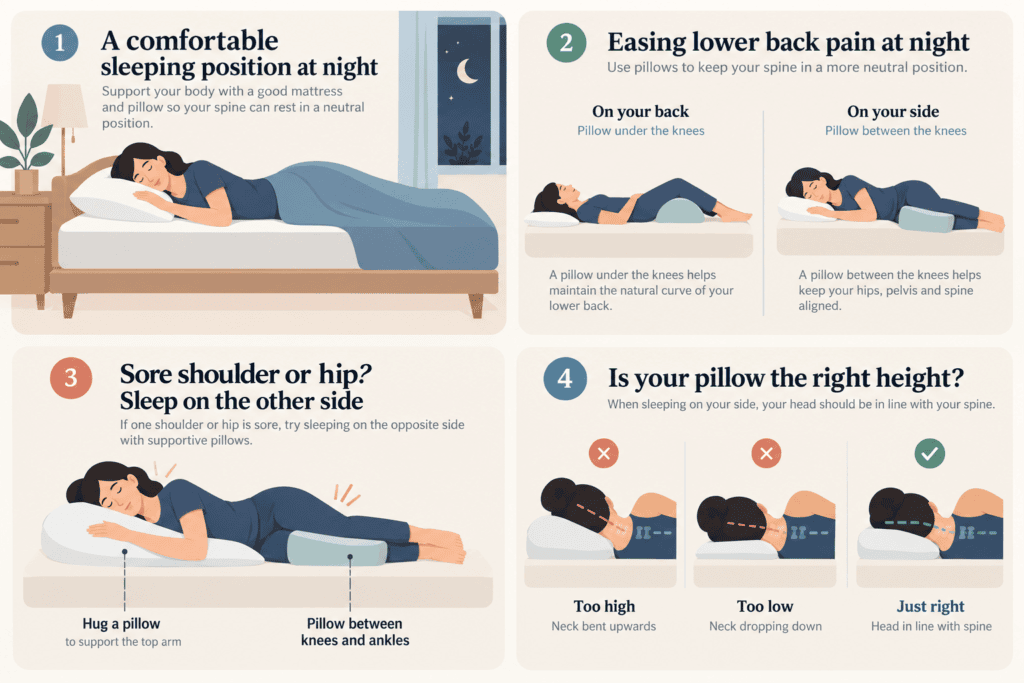
1. Lower back pain.
On your back, a pillow under your knees softens the curve in your lower back and takes pressure off the joints. On your side, a pillow between your knees keeps your pelvis level so your spine isn’t twisting through the night. Stomach sleeping tends to arch the lower back and is often the hardest position on it.
2. Neck pain.
Back and side sleeping are generally easier on the neck than stomach sleeping, which holds your head turned to one side for hours. The aim is for your head to sit roughly in line with the rest of your spine, not tipped up, down or sideways.
3. Shoulder pain.
Avoid lying directly on the sore shoulder where you can. Sleeping on the other side and hugging a pillow in front of you supports the top arm so it doesn’t drop forward. On your back, a small pillow under the sore arm can ease the pull through the front of the shoulder.
4. Hip pain.
If the outside of your hip is sore, lying on it often makes it worse. Sleep on the other side with a pillow between your knees and ankles so the top leg doesn’t drop across and stretch the sore area. Back sleeping with a pillow under the knees is another option.
Pillows and Mattresses: What Actually Matters
The bedding market is full of big claims. In practice, a few simple principles go a long way.
Your pillow should fill the gap between your head and the mattress, so your head stays in line with your spine. Panel 4 of the guide above shows what that looks like, and what happens when a pillow is too high or too low. Side sleepers usually need a higher, firmer pillow to cover the width of the shoulder. Back sleepers tend to do better with something lower that supports the neck without pushing the chin toward the chest. Stomach sleepers, if they stay that way, need very little height at all.
For mattresses, research generally favours medium firm over very firm for people with lower back pain. Too soft and you sink out of alignment. Too firm and pressure builds through the hips and shoulders. Comfort matters too. A mattress you sleep well on is doing more for your recovery than one that looks good on paper.
Before spending big, try the cheaper changes first. Rolled towels, a spare pillow between the knees or a mattress topper can tell you a lot about what your body responds to.
What to Watch For
A few signs it’s worth getting checked rather than just swapping pillows:
- Pain that wakes you regularly, whatever position you’re in
- Morning stiffness that takes more than 30 minutes to ease
- Pain that’s getting worse over a few weeks, not better
- Pins and needles, numbness or pain travelling down an arm or leg
- You’ve changed your pillow or mattress and nothing has shifted
It’s important to note that some stiffness after a bad night is normal, and not every sore morning needs treatment. If your pain is constant at night and no position eases it, or it comes with fever, unexplained weight loss or feeling generally unwell, see your GP.
What to Expect at Frame Osteopathy
When people come in with pain that’s worse at night or first thing in the morning, we’re not just treating the sore spot. We’re trying to understand what’s keeping it irritated.
That might mean working out which structures are sensitive, looking at how you sit and move during the day, or talking through your sleep setup in detail. You’ll leave with practical changes to try that night, not just a recommendation to buy something new.
We’re also evidence-based. Our advice on sleep positions and bedding is grounded in current research, not on whichever mattress is being advertised this month.
Do I Need a Special Orthopaedic Pillow?
Not necessarily. Many people do well with a standard pillow at the right height for how they sleep. A specialised pillow can help some people, but it’s worth trying simpler adjustments first.
Should I Change My Sleeping Position Straight Away?
Not if it’s stopping you from sleeping. Long-standing habits take time to change. Small adjustments, like adding a pillow between your knees, are often easier to stick with than switching positions overnight.